
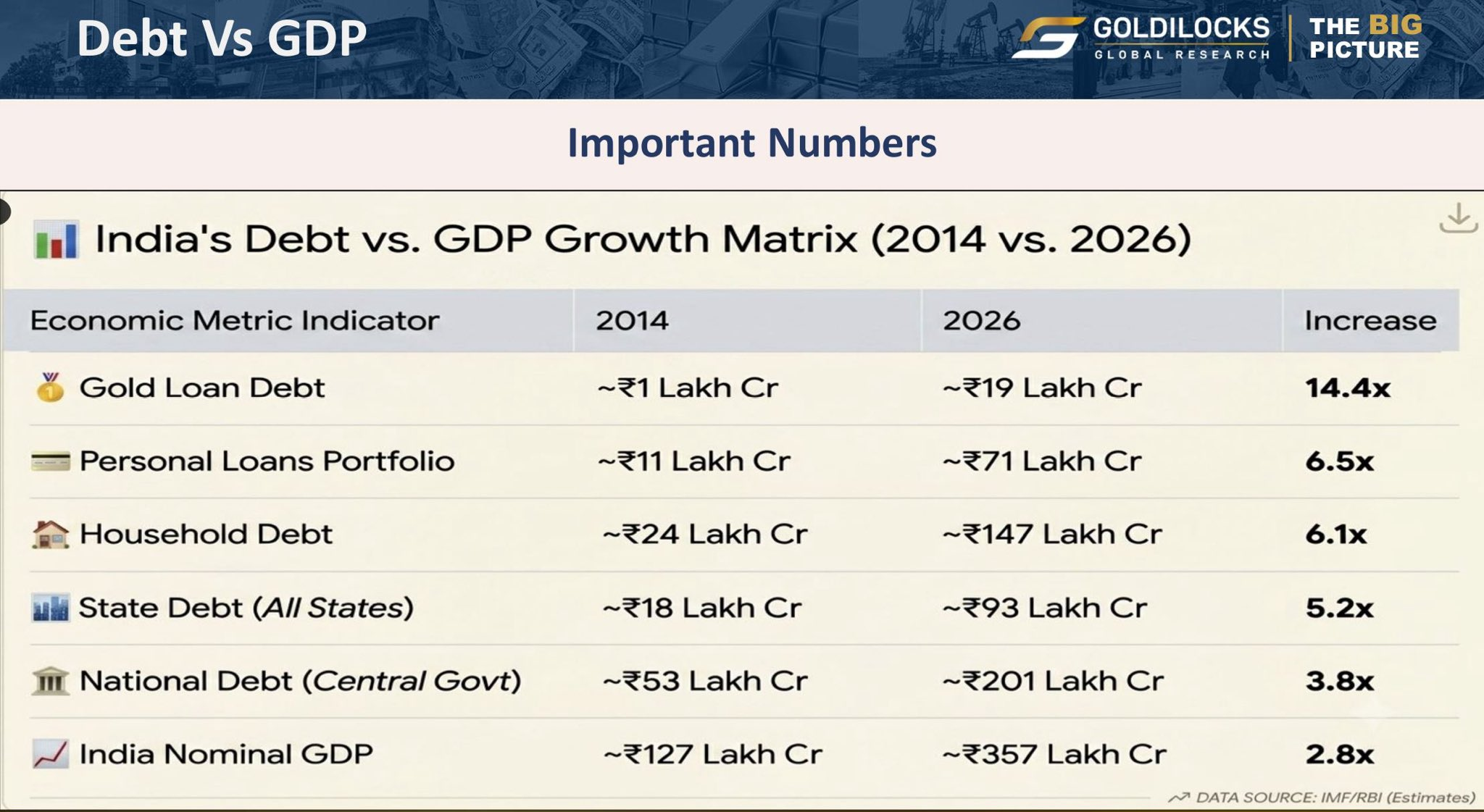
The chart highlights an important structural change in India over the last decade: debt across households, governments and consumers has grown significantly faster than nominal GDP in several categories.
What stands out?
1. Credit has expanded much faster than the economy
Nominal GDP has grown about 2.8×, while household debt has increased around 6.1×. This means credit has become a much larger part of the economic system.
2. Gold loans are the biggest outlier
Gold-loan debt has increased approximately 14.4 times. This reflects the rapid expansion of formal credit against gold, particularly among households and small businesses.
3. Personal borrowing has exploded
Personal-loan portfolios have grown 6.5×, considerably faster than GDP. Easy digital access to credit, consumer financing and greater formalisation of borrowing have contributed to this trend.
4. Government debt has also increased—but more slowly
Central government debt has risen 3.8×, while state debt has risen 5.2×. Both are above nominal GDP growth, although government debt needs to be assessed against tax revenues, economic growth and interest costs—not merely its absolute size.
Is this dangerous? Not necessarily.
Debt by itself is not the problem. The real question is:
Is debt being used to create productive assets and future income, or simply to fund consumption?
Borrowing to build a house, expand a business, invest in infrastructure or finance productive capacity can potentially support future economic growth.
Borrowing excessively for consumption, lifestyle expenses or to repay earlier debt can become problematic.
A simple takeaway>
India’s economy is growing, but India’s debt is growing even faster.
This is neither automatically good nor bad. The quality of borrowing matters more than the quantity of borrowing.
Productive credit can accelerate economic growth. Excessive consumption-led credit can create future stress.
Happy Investing!
RaVi
Standard Disclaimer: This is not an investment recommendation note, shared for education and information purpose only. Investments are subject to Market Risk, please read all the documents before investing. Fund Wallet is an AMFI registered distributor of Mutual funds with registration number ARN-111231.
Leave a Reply