
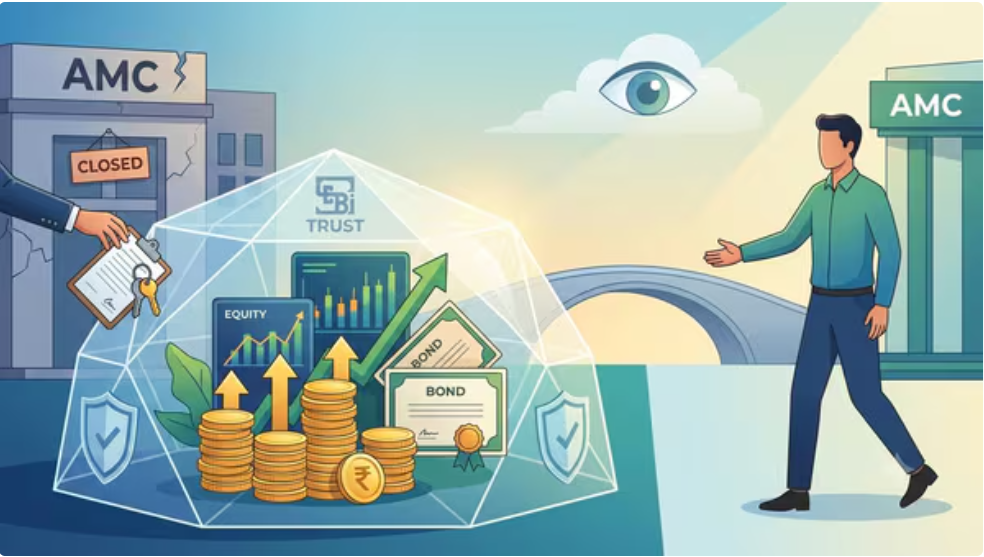
What happens to your mutual fund units if an AMC shuts down?
An important article from Livemint that addresses a common concern among mutual fund investors: What happens to our money if the mutual fund company closes down?
1. Your mutual fund units do not automatically disappear
When you invest in a mutual fund, the AMC manages the scheme but does not own the underlying investments.
For example, if you invest in an equity mutual fund, the shares purchased by that fund belong to the scheme’s unit holders. If the AMC stops operating, those shares do not simply become the property of the AMC’s promoters or creditors.
This separation is an important structural protection for investors.
2. What happens if the AMC is unable to continue?
There are several possible outcomes:
Transfer to another AMC: The mutual fund schemes may be transferred to another asset management company, subject to the applicable regulatory process. The new AMC takes over management of the schemes.
Merger of schemes: A scheme may be merged with another suitable scheme. Investors are informed about the proposed changes and applicable exit options.
Winding up of a scheme: If the scheme is closed permanently, its investments are liquidated and the proceeds are distributed to unit holders according to the applicable rules. The amount received depends on the value of the underlying investments, not the original amount invested.
3. The Franklin Templeton example
In April 2020, Franklin Templeton announced the winding up of six Indian debt mutual fund schemes.
The key issue was not that the AMC itself had become bankrupt. The funds faced severe liquidity pressures, making it difficult to meet redemption requests. The schemes held debt securities, including lower-rated and less liquid investments.
This case demonstrates an important distinction:
AMC risk and investment risk are not the same.
Even when the fund house continues to exist, investors can suffer losses because of credit defaults, falling security prices, or difficulty selling investments at a reasonable value.
4. The Morgan Stanley and other examples
| Year | AMC / Mutual Fund | What happened? |
|---|---|---|
| 2013 | Morgan Stanley Mutual Fund → HDFC Mutual Fund | HDFC acquired Morgan Stanley’s Indian mutual fund business. |
| 2014 | ING Mutual Fund → Birla Sun Life Mutual Fund | ING’s Indian mutual fund business was acquired by Birla Sun Life Mutual Fund. |
| 2015 | Deutsche Mutual Fund → DHFL Pramerica Mutual Fund | DHFL Pramerica acquired Deutsche’s Indian mutual fund business. |
| 2016 | Goldman Sachs Mutual Fund → Reliance Mutual Fund | Reliance Capital acquired Goldman Sachs Asset Management’s Indian mutual fund business. |
| 2016 | JPMorgan Mutual Fund → Edelweiss Mutual Fund | Edelweiss acquired JPMorgan’s Indian mutual fund business. |
| 2018 | L&T Mutual Fund → HSBC Mutual Fund | HSBC acquired L&T Investment Management’s mutual fund business. |
| 2019 | Reliance Mutual Fund → Nippon India Mutual Fund | Nippon Life Insurance acquired a controlling stake in Reliance Nippon Life Asset Management. |
| 2022 | IDFC Mutual Fund → Bandhan Mutual Fund | Bandhan acquired IDFC Asset Management Company and related mutual fund business. |
5. Does this mean mutual funds are completely safe?
No. The protection is not a guarantee of returns or capital.
Your investment remains exposed to:
- Equity market volatility.
- Credit risk in debt securities.
- Interest-rate risk.
- Liquidity risk.
- Poor investment decisions by the fund manager.
If an AMC closes, the value of your units will still depend on the underlying portfolio. A scheme holding high-quality, liquid investments is not exposed to the same risks as a scheme holding concentrated, lower-rated debt.
6. What should investors do?
For long-term investors, the key lesson is to focus on the quality of the scheme and its underlying investments, rather than worrying only about the size or reputation of the AMC.
A sensible approach is to review:
- The fund’s investment strategy.
- The quality and diversification of its portfolio.
- The track record and consistency of the fund manager.
- The risk associated with the underlying securities.
- Whether the fund fits your financial goals and time horizon.
Fund Wallet perspective
For HNI investors, this is a useful reminder that mutual fund selection should go beyond past returns and brand recognition.
A well-constructed portfolio should combine appropriate asset allocation, diversified investment strategies and disciplined risk management. The objective is not merely to select a large AMC, but to ensure that the underlying investments and overall portfolio structure remain aligned with the investor’s long-term financial objectives.
The most important takeaway: An AMC manages your investments, but the underlying assets belong to the scheme’s unit holders. An AMC closure does not automatically mean your investments disappear. However, the value of your units can still rise or fall depending on the investments held by the scheme.
Happy Investing!
RaVi
Mutual fund investments are subject to market risk, please read all the scheme related documents before investing. Fund Wallet is a AMFI registered Distributor of Mutual Funds with ARN-111231 as its registered number. This is not an investment recommendation in mutual funds just a note to highlight on some interesting article in Livemint an leading financial magazine.
Leave a Reply